
 Search



Sustainability
Education
Preparing Agents
of Change
Graduates today are faced with an uncertain and complex future. The way our students learn and are taught must change to stay current and effective.
We need to prepare our students not only with the appropriate knowledge but also with the necessary skills, values, and attitudes that will enable them to confront future challenges while actively and creatively contributing to human and planetary well-being and sustainable societies.
Our Approach 
Here at Frederick University, we aim for the holistic development of our students through an education with an emphasis on the 3H (Head, Heart, Hands).
We want our students to have the necessary knowledge (head) but at the same time, to have the appropriate skills (hands) and care (heart) so that, upon their graduation, they are able to face the turbulent future ahead but also -more importantly- they have the desire to become agents of change.
All three components are very important and, at Frederick University, there are different approaches through which they can be achieved:
· Incorporating the SDGs: We integrate the Sustainable Development Goals (SDGs) into the curriculum, enabling students to learn about sustainability regardless of their program of study.
· Action-Based Learning Initiatives: We offer initiatives based on a student-centred learning and teaching (SCLT) pedagogical approach. By providing students the opportunity to work on real-world projects or solve real-life challenges, we support the development of their sustainability competencies.
· Specialised Programs: We offer programs or courses focused on one or more SDG(s).
· Professional Practice: We focus on work-integrated learning experiences, internships, and mobility programs that prioritize sustainability.
· Interdisciplinary and Transdisciplinary Projects: These initiatives allow students to collaborate across diverse programs of study to tackle complex challenges.
Since the academic year 2022–2023, the University has undertaken a series of institutional initiatives to strengthen Education for Sustainable Development, including:
· Developing policies, rules, and regulations that enable student-centred learning and teaching.
· Creating a student-centred curriculum and pedagogy that help students develop the knowledge, skills, values, and attitudes necessary for building a more sustainable future.
· Designing active learning spaces that encourage student engagement and collaboration.
· Empowering faculty members through professional development programs focused on integrating the SDGs into their curriculum and teaching practices and in providing competence-based education for sustainable development.
· Establishing collaborations and partnerships that enable learners to engage with the community.
Frederick University ECOSYSTEM for ESDGs
Frederick University ECOSYSTEM for ESDGs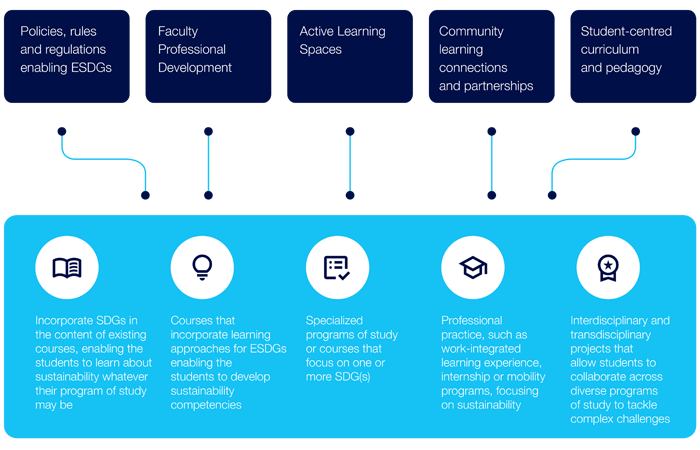
Why Competence-Based Education for Sustainable Development?
Since the academic year 2022-2023, Frederick University has focused on developing sustainability competencies to empower learners to tackle sustainability challenges and complexities. Education for Sustainable Development is as much about pedagogy as it is about teaching content. While learning about sustainability issues like climate, biodiversity, gender equality, health, and water quality is essential, Education for Sustainable Development emphasizes how we educate people to become critical, creative, and empowered citizens who can make a real difference in the world.
Competence is the ability to perform tasks successfully and efficiently. It combines knowledge, skills, attitudes, and personal traits demonstrated in a person’s behavior, enabling them to achieve objectives in work-related or other settings and conditions. In education, competencies are readily translated into measurable learning outcomes, facilitating both evaluation and assessment.
Competence-Based Education for Sustainable Development aligns academic goals with urgent global challenges, enriching university curricula by integrating critical thinking and real-world problem-solving into learning. This approach fosters adaptable, forward-thinking graduates who possess a holistic understanding and practical skills for positively impacting an increasingly complex world.
Students benefit from cross-disciplinary, integrative knowledge, raised ethical awareness, and a sense of purpose and responsibility. Additionally, this approach enhances employability, as sustainability competencies are highly valued in a sustainability-conscious job market. Students develop skills such as innovation, collaboration, teamwork, and effective communication, equipping them to become more versatile and impactful in their future careers.
At Frederick University we embrace sustainability education frameworks appropriate for the university context. One such example is FULL (Frederick University Living Lab).
Embedding Sustainability Competencies Across the Curriculum: A University-Wide Approach
Building on several years of faculty development and curriculum review, Frederick University took an important step in 2025 towards embedding Education for Sustainable Development (ESD) across its academic programmes.
In 2025, the University formally adopted and circulated to all academic departments a revised Course Outline Template, introducing dedicated sections for SDG-related learning outcomes and horizontal (transferable) skills, including sustainability competencies.
The revised framework encourages faculty members to identify learning outcomes linked to the SDGs, where directly relevant to course content, and to integrate sustainability competencies into teaching, learning and assessment activities across disciplines.
Drawing on the European GreenComp sustainability competence framework, particular emphasis is placed on developing competencies such as systems thinking, critical thinking, responsibility and futures literacy.
To support implementation, faculty members were provided with detailed guidance, practical examples and resources for incorporating these competencies into their courses.
This institutional initiative represents an important step towards making sustainability education an integral part of the learning experience at Frederick University, enabling students across different disciplines to develop the knowledge, skills, values and attitudes needed to contribute to a more sustainable future.
