
 Search



An exciting week for nuclear physics in Cyprus hosted by our University's CyNuclPhy Laboratory


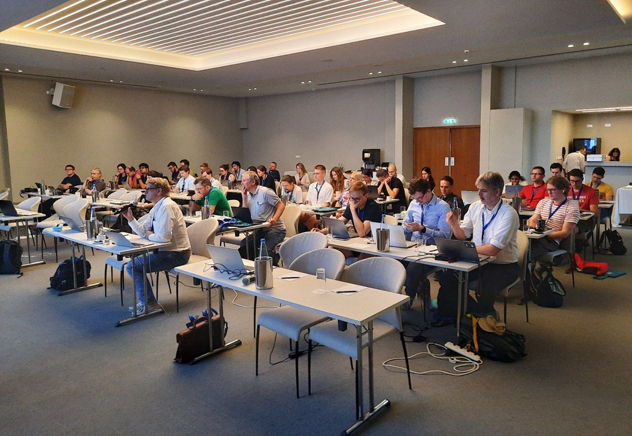
We are excited to announce the conclusion of the LI HADES Collaboration Meeting, hosted by Frederick University’s Cyprus Nuclear Physics Laboratory on 12-16 October in Larnaca, led by Professor Yiannis Parpottas.
Welcoming all participants, Prof. Parpottas thanked the organizing team and all who contributed to the meeting’s implementation that brought together 18 institutions from seven European countries.
Addressing the event, Frederick University’s Vice Rector for Research and Innovation, Prof. Haris Haralambous, congratulated the Laboratory on both hosting the meeting and its recent outstanding achievements.
The HADES spokesperson, Prof. Joachim Stroth, thanked the hosts and congratulated Prof. Francis Halzen on receiving the 2026 Nobel Prize in Physics.
The meeting featured 54 presentations across 11 sessions, with contributions from senior scientists alongside PhD students and postdoctoral researchers who shared ideas and received valuable feedback, highlighting the enthusiasm and promise of the next generation of HADES scientists.
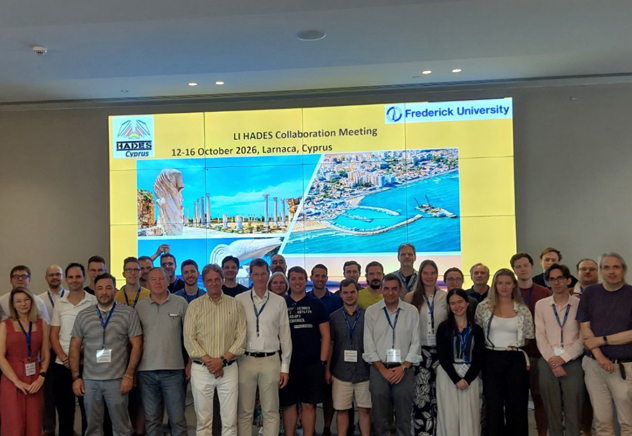
During the meeting, HADES reviewed new results from experiments at GSI, detector upgrades and priorities for future experiments. These studies explore nuclear matter under extreme conditions, helping us understand the fundamental physics of the early Universe and the behavior of matter in neutron stars and their mergers. The Collaboration Board also decided on future analyses, experiments and publications.
A highlight was the kick-off of the “FLOW-HADES” project, EXCELLENCE/0925/227, coordinated by Prof. Parpottas. Using high-statistics experimental data from silver-silver collisions, the project will precisely measure the collective flow of particles containing strange quarks. These flow measurements will test three theoretical models and help explain how dense nuclear matter behaves. The results are expected to fill gaps in global data at lower collision energies, providing valuable input for experimental and theoretical nuclear physicists and astrophysicists. The project is implemented through the EXCELLENCE HUBS Programme, under the “THALIA 2021-2027” Cohesion Policy programme, co-funded by the European Union through the Research and Innovation Foundation.
HADES’s planned move to the SIS100 accelerator at FAIR will enable experiments at higher beam energies and intensities, opening exciting prospects for studying rare particles and processes and making new discoveries.
In his closing remarks, Prof. Parpottas expressed his enthusiasm for the breadth of results presented and his gratitude to the young researchers whose work will sustain HADES in the years ahead.
With more than 19 years in HADES, our University's CyNuclPhy Laboratory looks forward to new discoveries at FAIR, bringing Cyprus and Frederick University into the next chapter of this international research effort.
 View all articles
